The Lovelock Hostage Bridge
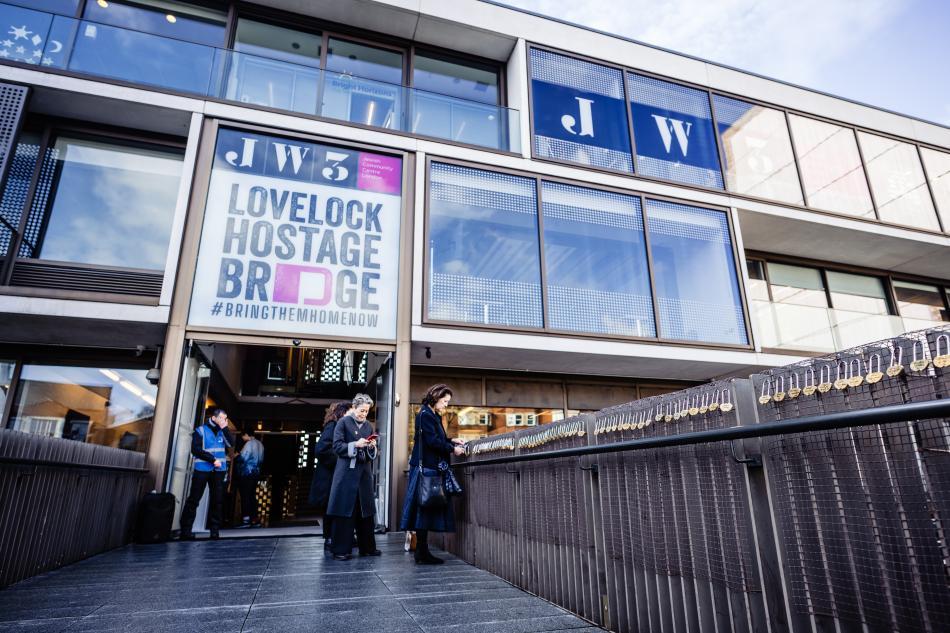
JW3’s Lovelock Hostage Bridge project began shortly after the events of October 7, when Marcel Knobil approached JW3 to discuss an idea for a public, visible way to highlight the ongoing plight of the hostages cruelly held in Gaza. In partnership with Marcel, and with Orit Eyal-Fibeesh’s 7/10 Human Chain Project, we developed the idea into a living, growing art installation that invited members of the public to show their love and support for the hostages.
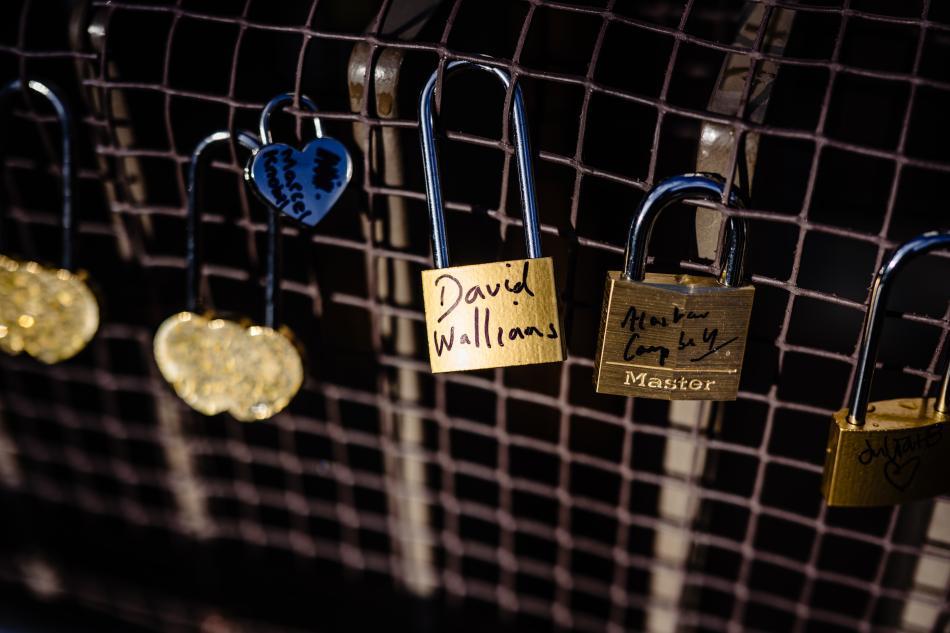
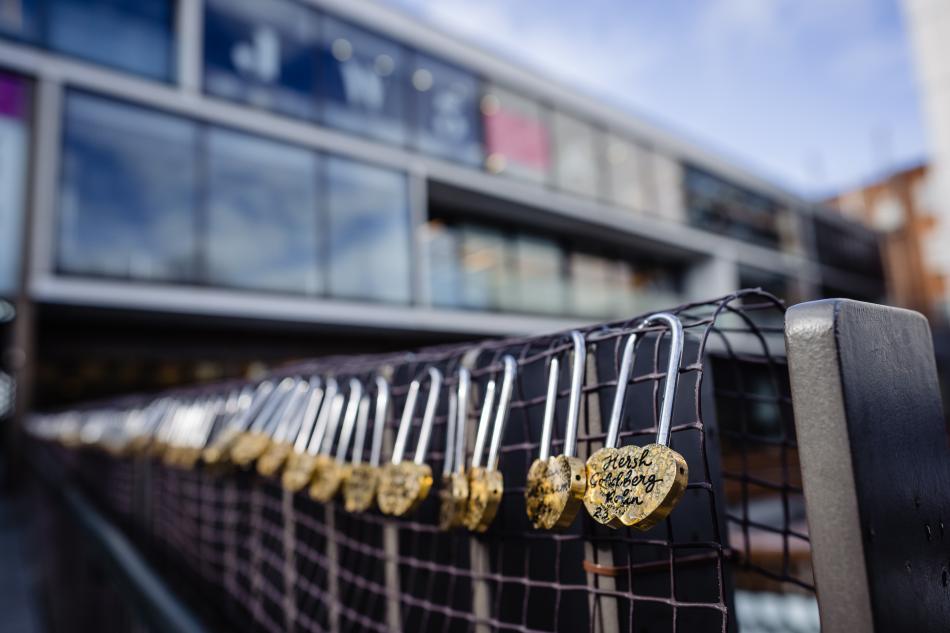
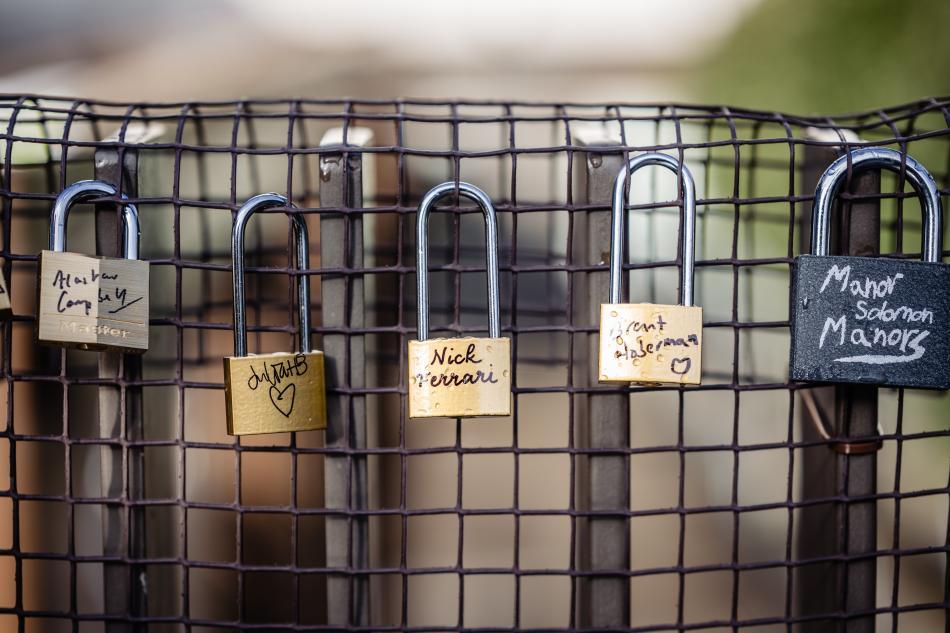
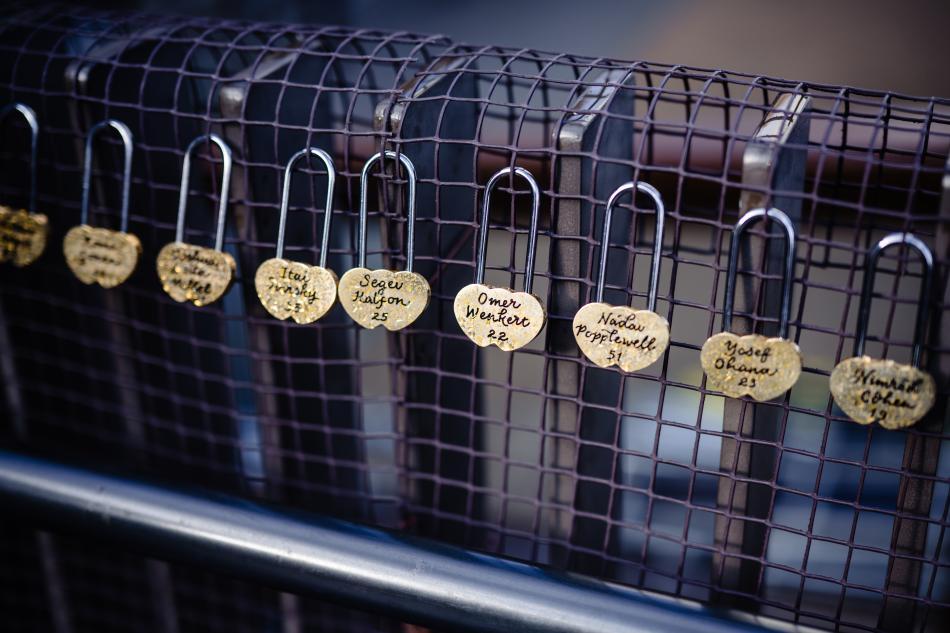
At the launch of Lovelock Hostage Bridge in February 2024, heart-shaped padlocks were installed along JW3’s bridge, each with the name of one of the hostages. They were accompanied by padlocks signed by numerous well-known personalities including: Alastair Campbell; Lilly Ebert MBE BEM z”l; Vanessa Feltz; Manor Solomon, Nick Ferrari; Mick Hucknell; Tracy-Ann Oberman MBE, Rachel Riley MBE, and a padlock signed by Uri Geller – bent, of course.
The ceremony included speeches from Dr Sharone Lifschitz (whose mother Yocheved had been released and father Oded z”l was still being held in Gaza – and later passed away there) and Dame Maureen Lipman. They attached their own padlocks to the Bridge, as did personalities including: Sir Iain Duncan Smith; Howard Jacobson; Sir Simon Schama; Sir Martin Sorrell; Anthea Turner; and Alan Yentob z”l.
In June 2024, the project expanded with Marcel’s creative idea to re-invigorate awareness of, and concern for, the plight of the hostages. Over fifty international artists - from Holland, Israel, Kenya, Morocco, South Africa, Venezuela, the US and the UK – created and decorated unique padlocks to express solidarity with the hostages with provocative and impactful creativity. These beautiful padlocks were displayed on the Bridge and then auctioned off to raise many thousands of pounds for the Hostages and Missing Families Forum.
Between February 2024 and October 2025, more than 5,000 padlocks were attached to the bridge, creating a large-scale installation that demonstrated the scale of community engagement with this humanitarian situation. JW3’s Lovelock Hostage Bridge became a location for visitors wishing to express solidarity, learn more about the hostages, and have some cathartic time. Over 250,000 people crossed the bridge during this time, and millions more were exposed to the project through international television and print media, and social media coverage.
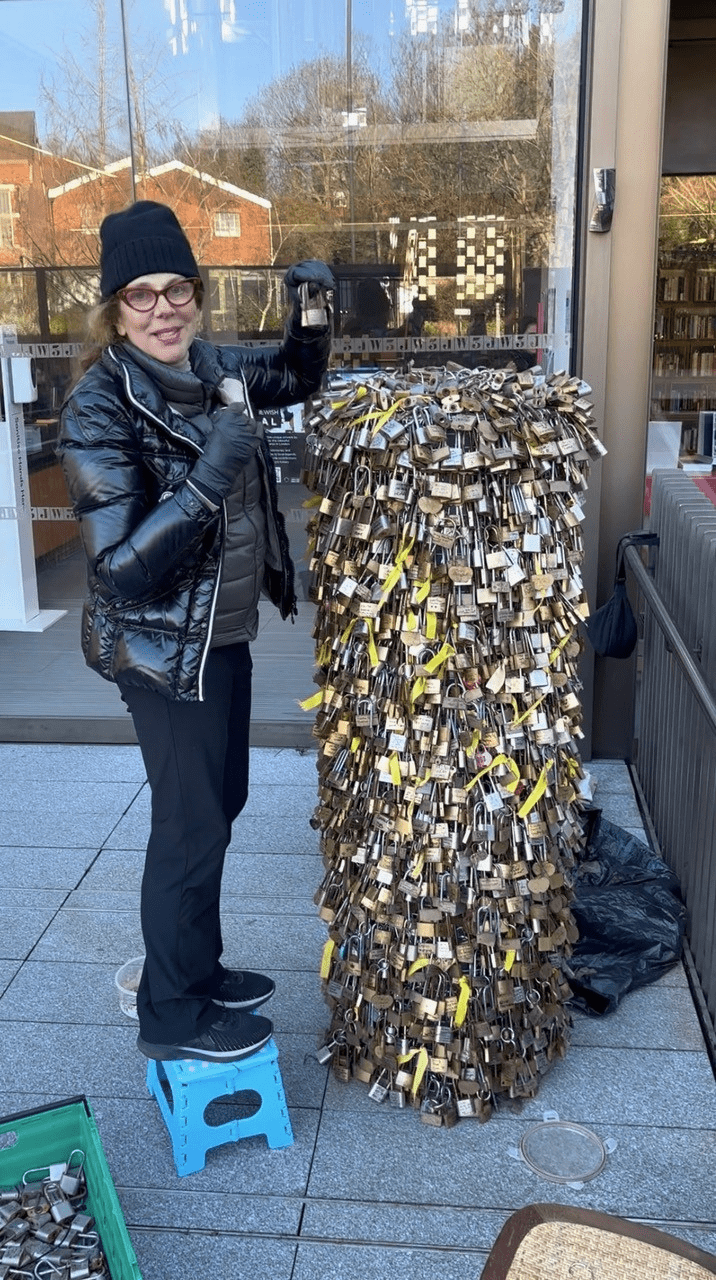
Following the release of the remaining living hostages in October 2025, we fulfilled our promise to the hostage families, and dismantled the installation. Working in partnership with Marcel, we commissioned artist Sandra Shashou – one of the artists who had donated a unique artistic lock in 2024 – to design and create a sculpture from hundreds of the locks, as a permanent tribute.
Lovelock Hostage Bridge Tribute
This sculpture is formed from padlocks that were amongst many thousands attached by members of the public to JW3’s Lovelock Hostage Bridge. The sculpture was created in situ, and unveiled on Sunday 29 March, 2026.
According to the artist Sandra Shashou: “I wanted to create a symbol not only of captivity, but of release. Not only of pain, but of resilience. As I read the messages on each of the thousands of padlocks, I felt the depth of love, hope, and heartbreak they carried. The act of locking something is often about holding on, but here, in their transformation, these locks also represent letting go, remembrance, and the enduring strength of a community that refused to forget. The padlocks carried the voices of so many people - their prayers, their anguish, their unwavering hope. To me, it was essential that they be transformed into something lasting. Something that would continue to speak.”
About the artist:
Sandra Shashou was born in Rio de Janeiro, and in the year 2000 studied at City & Guilds of London Art School.
In recent years Shashou has exhibited in London, Paris, Beirut, Geneva, Gstaad, St Tropez, Dallas, Miami, NYC, and Venice. She has been shown in Art Elysees, Art Beirut, Art Palm Beach, Art Miami, Art Southampton NY, Armoury Antiques NY, Art15 Olympia London, Sotheby’s, Christie’s and Phillips, and has been commissioned for site-specific public sculptures in the US, EU, and UK. Her work has been collected in several important private collections.
Sandra generously donated her time and talent to this project.
Lovelock Hostage Bridge - Images by Blake Ezra Photography■