

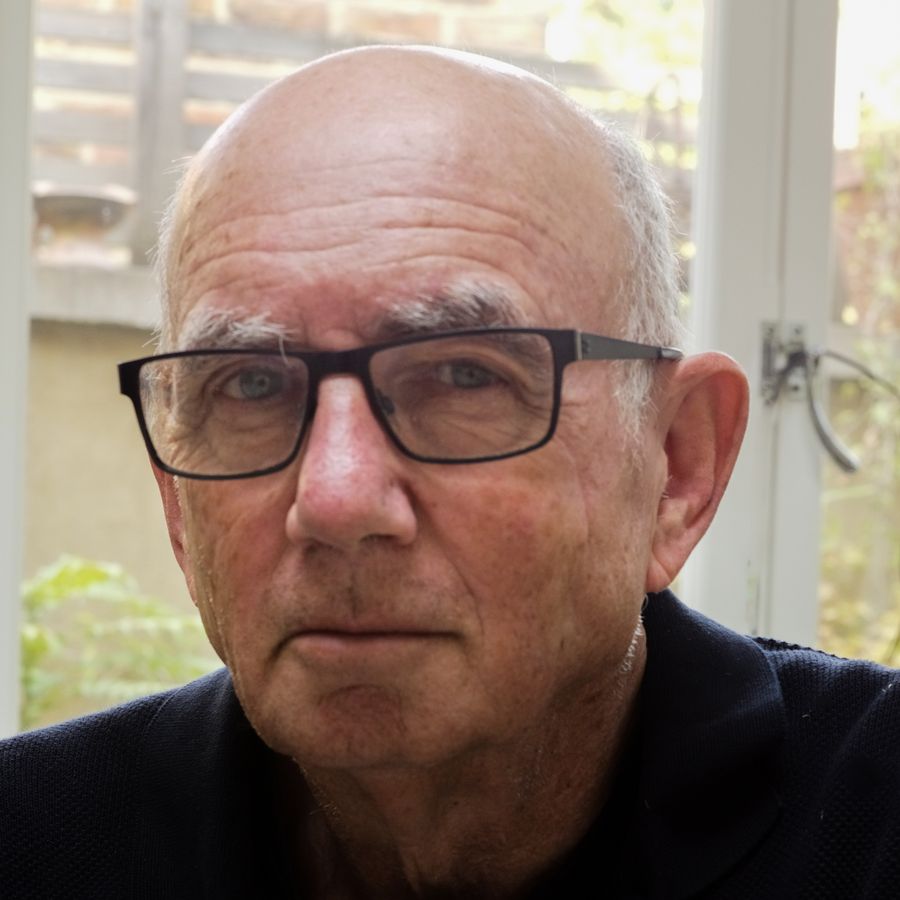
Allan Leas
Writer
Allan Leas is a London-based playwright, human rights advocate, photographer, documentary filmmaker and former actor whose creative and professional life has been shaped by questions of exile, identity, persecution and the enduring effects of political conflict.
Born in South Africa, Allan became involved in the anti-apartheid movement as a young man and left the country for Britain in the late 1970s. Granted political asylum in the UK, he became, within weeks of his arrival, a founder member of the Committee on South African War Resisters. His subsequent career has combined theatre and the arts with an international career in refugee protection and human rights.
His theatrical career began as an actor, with credits in BBC television and radio, Thames Television, the Young Vic and several repertory and fringe theatres. He subsequently turned increasingly to writing, directing and producing. His produced plays include Forms, Equiano, Whores of War, Devil’s Peak, Nightingale Power, and Through Savage Europe. His work has been staged at the Croydon Warehouse Theatre, Yvonne Arnaud Theatre, Thorndike Theatre, Redgrave Theatre and Etcetera Theatre.
In 1982, the Royal Court selected Devil’s Peak for a year-long period of development towards production. Although the production ultimately did not go ahead after the director left to join the BBC, the play was subsequently produced at the Croydon Warehouse Theatre in 1985, where it attracted reviews in several British newspapers. The Observer described it as an “unaccountably under-noticed – deeply touching, and a very funny play”, while The Times called it “exhilarating relevant theatre – a triumph in concept and execution”. Equiano was similarly well received, with Bridget Grant writing in The Independent that Leas’s play was “a first class piece of writing”.
Through Savage Europe, a play partly about the founding of Israel and the experience of Jewish refugees in post-war South Africa, was produced by BBC Radio in 1992 and is currently being developed for the stage.
Alongside his theatrical work, Allan has pursued a career in photography and documentary filmmaking. His photographs have appeared in The Guardian, in several books, and he has written and directed documentaries on subjects including Kristallnacht, the financial crisis in Greece and the struggle of refugees to reach Europe.
For many years, Allan worked at the forefront of international refugee protection. He began as a staff writer and Africa Committee Coordinator at the Refugee Council, before spending many years with the European Council on Refugees and Exiles (ECRE), where he held senior positions including Secretary General. His work has taken him extensively across Europe, Africa, the Middle East, Turkey and the former Yugoslavia.
From 2013 to 2015 he was Spokesman on Refugee Protection for the European Union Agency for Fundamental Rights. He was also Executive Director of AMERA (Africa and Middle East Refugee Assistance). As an independent consultant, he has worked with organisations including UNHCR, UNDP, Open Society, SPANA and the Dutch Council for Refugees, undertaking assignments in Africa, the Middle East, Central and Eastern Europe and the Balkans. He has worked on asylum systems, EU asylum law, refugee rights, statelessness and institutional capacity-building. He served for ten years as Chair of the Board of the European Network on Statelessness and is a founder trustee of Hawiati, a network concerned with statelessness in the Middle East and North Africa.
He is the author of two books: South Africa: Reform or Revolution (1992) and The Abolition of the Slave Trade (1989).
Much of Allan’s writing draws on personal and family history, exploring the relationship between political events and private lives. His current play, Trudy Zeller Lives Here, is a serious comedy about an elderly Jewish German woman living in Britain, her daughter, and the secrets and inherited memories that divide generations. It explores Jewish and German identity, displacement, guilt, survival and the continuing impact of Europe’s history on those who experienced it and their children.
Across his work in theatre, documentary filmmaking and refugee protection, Allan has maintained a longstanding interest in the ways that history is carried by individuals - and in how people construct lives, identities and relationships in the aftermath of displacement.